
Free GED Science Practice Test
The GED Science test is a 90-minute, single-section test. It covers three content areas: Life Science (40%), Physical Science (40%), and Earth and Space Science (20%). The two themes of the test are Human Health and Living Systems and Energy and Related Systems. It tests your ability to apply reasoning skills to topics within these content domains and themes.
Start Test
Our GED®Science Practice will help you pass faster
- GED® Science Practice Test 1 (25 Items)
- GED Science Practice Test 2 (25 Items)
- GED Science Practice Questions ( Tons of Questions )
- Science Practice Lessons ( 10 Lessons )
Check out our other Free GED© Practice Test
A Quick Guide to GED Science Test
You will find multiple choice, drop-down, hot spot (select an area), fill-in-the-blank, and drag-and-drop items, according to GED Testing Service's subject page. The Science test no longer has short-answer (written) items.
Many questions still ask you to read a passage or data display and reason about an experiment. Get more tips on our GED Science page.
An on-screen TI-30XS calculator and a calculator reference sheet are available during the test. At a test center you may also bring your own TI-30XS MultiView calculator; online testers use the on-screen one.
Start studying or reviewing with our helpful contents to get good GED Science test score: GED Science Classes Online
The Science GED test will check whether you can do these things:
- Analyze and explain textual scientific presentations.
- Determine the meaning of symbols, terms, and phrases in a scientific presentation.
- Analyze and explain non-textual scientific presentations.
- Comprehend and apply scientific models, theories, and processes.
- Use formulas from scientific theories.
- Identify sources and causes of error.
- Change the design of an investigation to correct an error.
- Identify and refine hypotheses for scientific investigations.
- Identify the strength and weaknesses of one or more scientific investigation designs.
- Design a scientific experiment.
- Identify and interpret independent and dependent variables in scientific experiments.
- Cite specific textual evidence to support a finding or conclusion.
- Reason from information or evidence to a conclusion.
- Make a prediction based on data or evidence.
- Use sampling techniques to answer scientific questions.
- Check whether a conclusion or theory is supported or challenged by data or evidence.
- Check findings, conclusions or theories.
- Express scientific information or findings using visuals.
- Express scientific information or findings using numbers or symbols.
- Express scientific information or findings in words.
- Describe a data set through statistics.
- Use counting and permutations to solve scientific problems.
- Determine the probability of events.
Learn more: GED 101: 2021 GED Practice Tests, GED Classes for GED Exam – 1 Stop GED Programs Guide
Quick Tips to Remember When Preparing for the GED Science Test
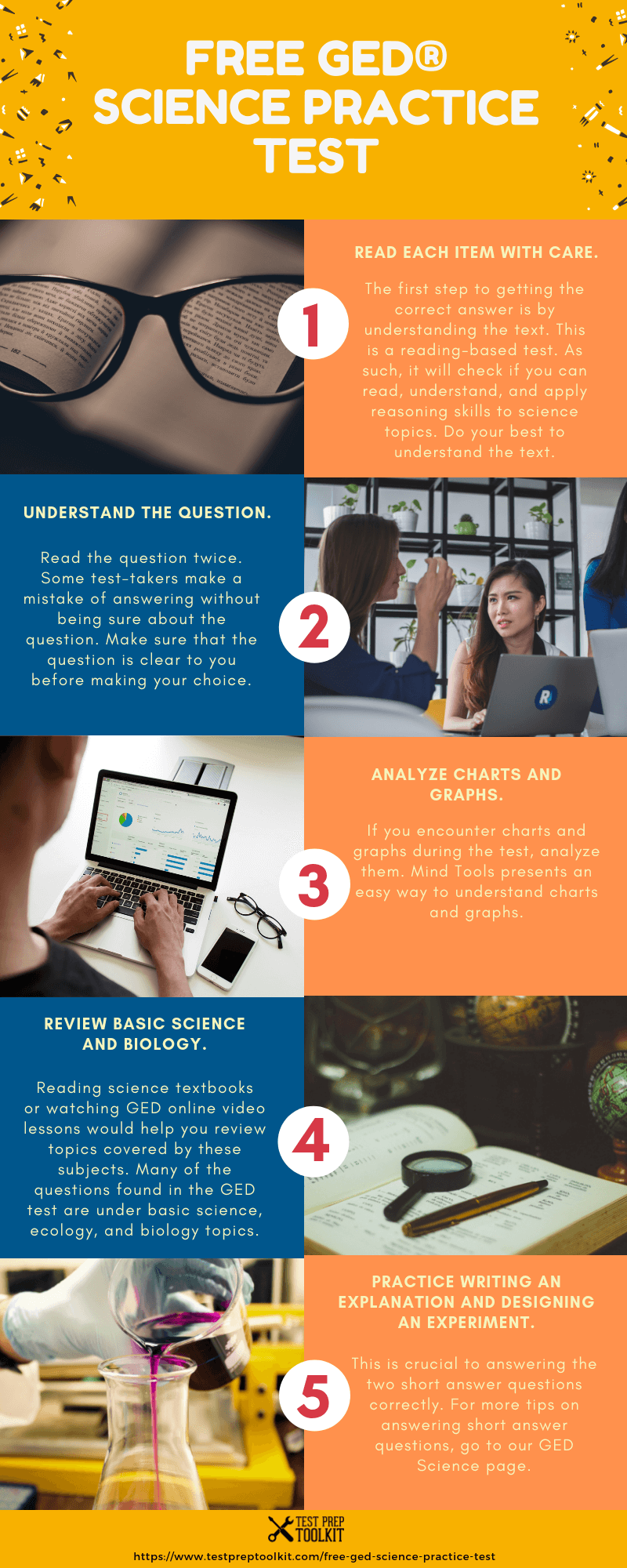
- Read each item with care.

The first step to getting the correct answer is by comprehending the text. This is a reading-based test. As such, it will check if you can read, comprehend, and apply reasoning ability to science topics. Do your best to comprehend the text.
To improve your understanding of science topics and terms, take GED science practice tests and attend GED online classes. Ours follow the topics on the actual exam.
Start reviewing with our contents: GED® Science Study Guide
- Understand the question.
Read the question twice. Some test-takers answer before they are sure what the question asks. Make sure the question is clear to you before you choose.
- Analyze charts and graphs. Expect charts and graphs, and read their titles, labels and units before answering. Mind Tools presents an easy way to analyze charts and graphs.
Check our website: Free GED® Classes Online for the GED® Exam
- Review basic science and biology.
Studying science textbooks or watching GED online video lessons helps you review these topics. Life science makes up 40% of the test, so biology and ecology deserve real study time.
Check our Free GED® Classes Online for the GED® Exam
- Practice designing and interpreting experiments. Designing and Interpreting Science Experiments is one of the test's core skill areas. For more tips, go to our GED Science page.
Get Early Access to our GED Math Video Course containing 45+ Video Lessons, 500+ Practice Questions, and Tons of Downloadable Worksheets
Related Topics:
- Free GED Practice Test
- GED® Reasoning Through Language Arts Practice Tests
- GED Social Studies Classes Online
- GED Math
- GED® Social Studies Prep Guide
- GED Study Guide
- GED Reasoning through Language Art PRACTICE TEST
Sources
- GED Test Subjects, GED Testing Service
- GED 101: An Introduction to the GED Program and the GED Test, GED Testing Service