
Free GED Social Studies Practice Test
Our GED Social Studies practice test questions are designed to help you study for the GED test. It’s never too late to prepare.
Start Test
- GED Social Studies Practice Test ( 25 Questions )
- GED® Social Studies Lessons (10 Lessons)
- GED® Social Studies Practice Questions ( Tons Questions )
A Quick Guide to GED Social Studies Test
The GED Social Studies test is a single-section test that you need to finish in 70 minutes or less. Many people make the mistake of studying only history.
U.S. history is just 20% of the test. Civics and Government is 50%, Economics 15%, and Geography and the World 15%, according to GED Testing Service's test overview.
While the test has four topics, it only has two themes. The first theme, the Development of Modern Liberties and Democracy, looks at how democracy and civil rights developed from the earliest civilizations to the present. This includes the events that helped shape our democratic society.
The second theme, Dynamic Responses in Societal Systems, studies how systems, structures and policies respond to each other and to conditions and events.
Like the other subjects, this test includes several types of questions. These are multiple-choice, fill-in-the-blank, drop-down, hot spot (select an area), and drag-and-drop. There is no essay on this test, and an on-screen calculator is available. Take our free GED practice test for social studies now to get an idea about the types of test items you’ll see in the exam.
The test will check your ability to analyze and understand text about social studies. It will also check your reasoning skills and problem-solving skills when it comes to this subject.
More review materials HERE
What Will You Find in the GED Social Studies Practice Test?
You will be reading passages or text that will ask you to do any of these:
- Make logical inferences or valid claims based on evidence
- Know the meaning of social studies words and phrases
- Cite or identify specific evidence to support inferences or analyses
- Know the central ideas or information of a document
- Describe people, places, and events and describe the connections between and among them.
- Distinguish fact from opinion
- Identify instances of bias or propagandizing
- Identify pieces of evidence that the author uses to come up with conclusions
- Analyze how a historical context forms an author’s opinions
- Compare differences in social studies topics
- Analyze information presented through maps, graphics, tables, and charts.
- Translate numerical information into words
- Check the credibility of an author in historical and contemporary studies
- Identify the order of a historical narrative
Check our GED® Social Studies Prep Guide
Quick Tips to Remember When Preparing for the GED Social Studies Test
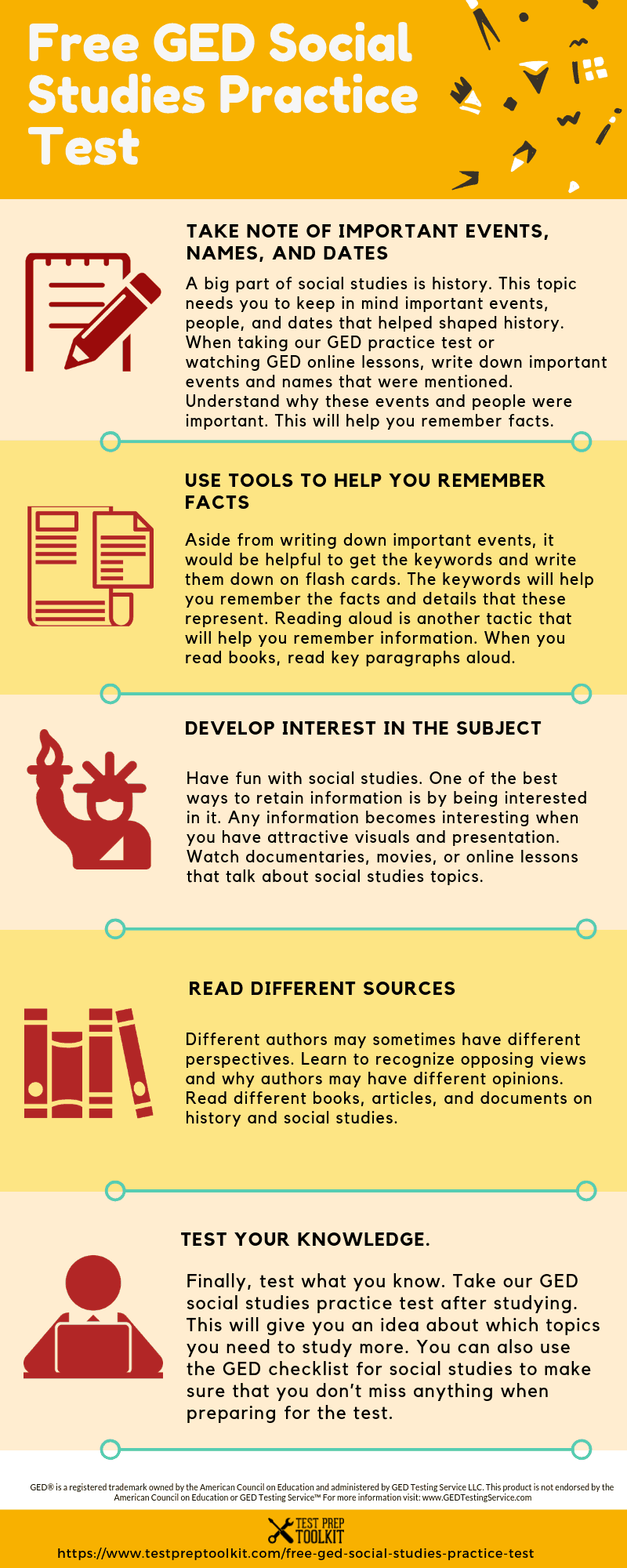
- Take note of important events, names, and dates.

History asks you to keep in mind important events, people, and dates that helped shape the country. When taking our GED practice test or watching GED online lessons, write down important events and names that were mentioned. Understand why these events and people were important. This will help you remember facts.
When it comes to dates, it would also help if you draw a timeline of events. For example, you can draw a timeline of how civilizations developed, starting from the ancient Egyptian civilization. This will help you understand how and why each event happened. It also increases retention.
We have Social Studies Practice Lessons
- Use tools to help you remember facts.
Aside from writing down important events, it would be helpful to get the keywords and write them down on flash cards. The keywords will help you remember the facts and details that these represent.
Reading aloud is another tactic that will help you remember information. When you read books, read key paragraphs aloud.
Check our Free GED Math Practice Test
- Develop interest in the subject.

Have fun with social studies. One of the best ways to retain information is by being interested in it. Any information becomes interesting when you have attractive visuals and presentation. Watch documentaries, movies, or online lessons that talk about social studies topics.
Check our Free GED® Classes Online for the GED® Exam
- Read different sources.
Different authors may sometimes have different perspectives. Learn to recognize opposing views and why authors may have different opinions. Read different books, articles, and documents on history and social studies.
Learn more about Free GED Practice Tests (2021)
- Test your knowledge.

Finally, test what you know. Take our GED social studies practice test after studying. This will give you an idea about which topics you need to study more. You can also use the GED checklist for social studies to make sure that you don’t miss anything when preparing for the test.
Related Topics:
- GED® Reasoning Through Language Arts Practice Tests
- Free GED® Science Practice Test
- GED Study Guide
- GED Math Video Lessons
- GED Social Studies Classes Online
- Free GED Social Studies Practice Test
- GED Study Guide
- GED Math Practice Test 1
- GED Plus Program Offers Kentucky Students Tuition-Free Certificates
Sources
- GED Test Subjects, GED Testing Service
- GED 101: An Introduction to the GED Program and the GED Test, GED Testing Service