
SAT Scores
One of the most frequently asked questions about the SAT is how the scores are calculated. Just as you learn the rules before you play a game, you should know how the SAT is scored before test day.
Why Should You Understand How the SAT is Scored?
Know your strengths. The sections where you scored better will tell you a lot about your potential. If you’re still undecided about your college course, this will help you consider options where you know you will be able to do well.
Know what to improve on. If you are retaking the test, focus on preparing for the sections where you scored low. This will help improve your overall score.
Set goals. Knowing how the SAT is scored will help you set score goals for your scholarship and college applications.
Related Topic: SAT Math Practice Test
How SAT Scoring Changed
Before March 2016: Wrong multiple-choice answers cost a quarter point, so guessing could lower your score.
Related Topic: SAT Test Dates
From March 2016: The guessing penalty was dropped. Your raw score was simply the number of questions you got right, converted to a scaled score with a table.
Since the digital SAT (2024 in the U.S.): Scores are no longer a simple count of right answers. The test is adaptive, and your score depends on which questions you answered correctly and how hard they were.
- Raw vs Scaled Scores
- Raw SAT Scores
- SAT Scaled Scores
- SAT Composite Scores
- Practice Tests Will Give You A Clue
Raw vs Scaled Scores

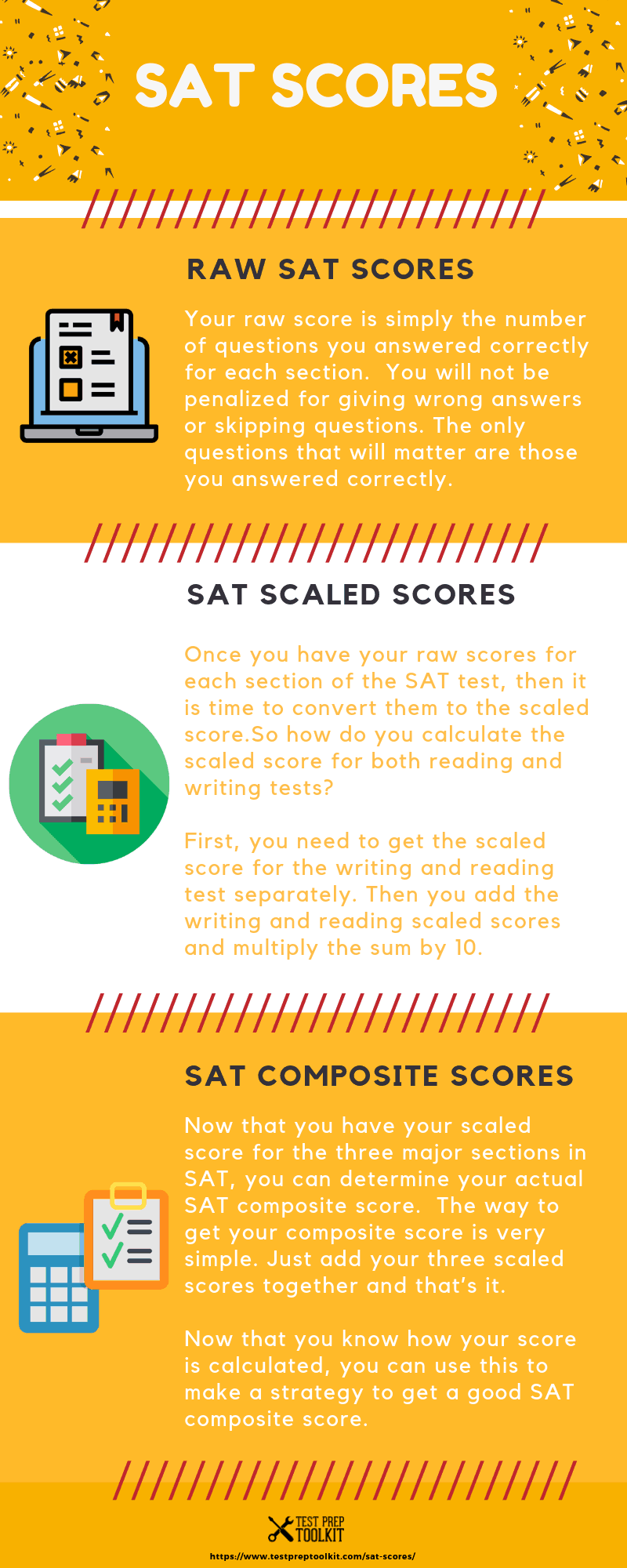
Raw SAT Scores
On the digital SAT, the number of questions you get right doesn't convert to a score through one fixed table. Here is how many questions each section has:
- Reading and Writing: 54 questions in 64 minutes
- Math: 44 questions in 70 minutes
Each module also includes two unscored pretest questions. You can't tell which ones they are, so answer every question as if it counts.
There is no penalty for wrong answers. College Board advises guessing rather than leaving a question blank, especially if you can eliminate one or two choices.
Related Topic: SAT Requirements
SAT Scaled Scores
The digital SAT uses Item Response Theory to calculate scores. Your score reflects which questions you answered correctly, how difficult they were, and whether your answer pattern suggests guessing.
That means two students with the same number of correct answers can get different section scores. It also explains why tables that convert raw scores to scaled scores no longer apply.
Each module counts. The first module in each section decides whether you get an easier or harder second module, so careless mistakes early on can limit your top possible score.
Each section is scored from 200 to 800 in 10-point steps:
- Reading and Writing: 200-800
- Math: 200-800
Related Topic: SAT Practice Tests
SAT Composite Scores

Your total SAT score ranges from 400 to 1600. It combines your Reading and Writing and Math section scores.
For example, a 660 in Reading and Writing and a 700 in Math gives you a total of 1360.
Your score report also shows a score range, percentiles comparing you with other test takers, and a Knowledge and Skills graphic for eight content areas. Use these to set goals, since Math counts for half of your total.
Related Topic: SAT Registration
Practice Tests Will Give You A Clue
SAT practice tests are based on the actual SAT test.
Official full-length practice tests in College Board's Bluebook app are adaptive like the real test. That makes them the best predictor of how you will do.
Related Topic: SAT Overview, Registration, SAT Subjects, Test Dates, & Tips To Prepare For High SAT Scores
SAT practice tests will tell you what your strong and weak areas area.
If your Math score lags behind, study the topics where you make the most mistakes. Know your weak areas and focus on these.
The best way to get a good SAT score is a study plan. Follow a consistent schedule and take practice tests to learn the test structure and find areas to improve.
SAT Practice tests are not only a diagnostic tool, but also a memory enhancer tool!
Practice tests help you remember concepts you've reviewed as you put them to use. Study for both sections, since each one is half of your score.
Related Topics:
- SAT Reading Practice Tests
- SAT Writing Practice Tests
- SAT Scores
- SAT Science Test, Topics & Subjects Content
- How To Choose Your SAT Subject Tests: Highlight Your Academic Strengths And Interests
- SAT vs ACT, Which One Should You Take?
- ACT vs SAT
- SAT French Subject Test? Here’s What You Should Know
- How To Get A Good SAT Reading Score: 6 Important Test-Taking Strategies
Sources
- How Are Scores Calculated?, College Board
- Understanding SAT Scores, College Board
- SAT Structure, College Board