Social Studies Practice Test 1 – GED Free Online Practice Tests
GED free online practice test for social studies to improve your GED scores. Try our practice questions to prepare for all subjects and pass your GED. Social studies practice test 1 questions are based on latest GED exam that will help you ace your GED. It’s never been late to start preparing for the GED test. So, don’t wait anymore and start with our free practice tests for all subjects.
This practice test covers all the relevant topics of the original GED social studies test. Each question will help you learn and improve your knowledge.
The test is divided into four major categories: 1. Civics and government (50%) 2. US history (20%) 3. Economics (15%) 4. Geography of the world (15%).
The official GED social studies test is a single section test. You have 70 minutes to finish the exam. You need to get at least 145 points to pass this test.
Use this same passage to answer the next 2 questions: 1 of 3 questions using this passage complete
“…As people move, so do microbes. HIV/AIDS, tuberculosis, and malaria together cause 25 percent of all deaths worldwide. With an estimated 40 million people already infected, the national security threat posed by HIV/AIDS is no longer theoretical or prospective; it is clear and present today. It is, moreover, rapidly expanding its deadly reach beyond Sub-Saharan Africa. In the last 5 years, for instance, the HIV/AIDS infection rates in Eastern Europe increased 1300 percent. Even relatively low rates of infection will have enormous consequences for high population countries such as China and India. HIV/AIDS is particularly devastating because it often combines with other infectious diseases””notably tuberculosis””in lethal alliances. To make matters worse, drug-resistant strains of tuberculosis are becoming more prevalent. Such strains can defeat the most sophisticated antibiotics in modern medicine’s arsenal.
The burden of infectious diseases can strain weak health systems to the breaking point and beyond, with pernicious effects on social, economic, and political stability of regions important to America’s interests. The hardest-hit nations in Sub-Saharan Africa are experiencing precipitous declines in life expectancies, some falling over 30 years. Millions of orphans will need to be raised by the poorest societies on earth; many, forced to fend for themselves or exploited by others, will pose a clear source of instability in affected areas. The spread of HIV/AIDS and other infectious diseases, therefore, will not only pose a health risk, but threaten to destroy societies, devastate economies, and destabilize entire regions. (Joint United Nations Programme on HIV/AIDS and World Health Organization, AIDS Epidemic Update, December 2001 (Geneva: UNAIDS, 2001); UNICEF, UNAIDS, and WHO, Coordinates 2002: Charting Progress Against AIDS, TB and Malaria (Geneva: World Health Organization, 2002).)
Haass, Richard N. (2007, April 14). Supporting US Foreign Policy in the Post-9/11 World: Policymakers and the Intelligence Community. Retrieved September 27, 2013 by, https://www.cia.gov/library/center-for-the-study-of-intelligence/csi-publications/csi-studies/studies/vol46no3/article01.html
What evidence does the author use to support the idea that microbes move with people with devastating effects?
A. The spread of HIV/AIDS and other infectious diseases, therefore, will not only pose a health risk, but threaten to destroy societies. B. HIV/AIDS, tuberculosis, and malaria together cause 25 percent of all deaths worldwide. C. In the last 5 years, for instance, the HIV/AIDS infection rates in Eastern Europe increased 1300 percent. D. Both B and C
C. In the last 5 years, for instance, the HIV/AIDS infection rates in Eastern Europe increased 1300 percent.
Question 1 of 25 (click ‘Next Page’ at the bottom right of the page to go on to the next question.)
4 % Complete
Read the below passage and use it to answer the next 3 questions: “…As people move, so do microbes. HIV/AIDS, tuberculosis, and malaria together cause 25 percent of all deaths worldwide. With an estimated 40 million people already infected, the national security threat posed by HIV/AIDS is no longer theoretical or prospective; it is clear and present today. It is, moreover, rapidly expanding its deadly reach beyond Sub-Saharan Africa. In the last 5 years, for instance, the HIV/AIDS infection rates in Eastern Europe increased 1300 percent. Even relatively low rates of infection will have enormous consequences for high population countries such as China and India. HIV/AIDS is particularly devastating because it often combines with other infectious diseases””notably tuberculosis””in lethal alliances. To make matters worse, drug-resistant strains of tuberculosis are becoming more prevalent. Such strains can defeat the most sophisticated antibiotics in modern medicine’s arsenal.
The burden of infectious diseases can strain weak health systems to the breaking point and beyond, with pernicious effects on social, economic, and political stability of regions important to America’s interests. The hardest-hit nations in Sub-Saharan Africa are experiencing precipitous declines in life expectancies, some falling over 30 years. Millions of orphans will need to be raised by the poorest societies on earth; many, forced to fend for themselves or exploited by others, will pose a clear source of instability in affected areas. The spread of HIV/AIDS and other infectious diseases, therefore, will not only pose a health risk, but threaten to destroy societies, devastate economies, and destabilize entire regions. (Joint United Nations Programme on HIV/AIDS and World Health Organization, AIDS Epidemic Update, December 2001 (Geneva: UNAIDS, 2001); UNICEF, UNAIDS, and WHO, Coordinates 2002: Charting Progress Against AIDS, TB and Malaria (Geneva: World Health Organization, 2002).)
Haass, Richard N. (2007, April 14). Supporting US Foreign Policy in the Post-9/11 World: Policymakers and the Intelligence Community. Retrieved September 27, 2013 by, https://www.cia.gov/library/center-for-the-study-of-intelligence/csi-publications/csi-studies/studies/vol46no3/article01.html
According to the text, what threatens to destabilize entire regions?
A. Civil war B. The spread of HIV/AIDS and other infectious diseases. C. Millions of orphans will need to be raised by the poorest societies on earth. D. Decline of life-expectancy in Sub-Saharan Africa.
B. The spread of HIV/AIDS and other infectious diseases
Use this same passage to answer 1 more question: This is the last question using this passage.
“…As people move, so do microbes. HIV/AIDS, tuberculosis, and malaria together cause 25 percent of all deaths worldwide. With an estimated 40 million people already infected, the national security threat posed by HIV/AIDS is no longer theoretical or prospective; it is clear and present today. It is, moreover, rapidly expanding its deadly reach beyond Sub-Saharan Africa. In the last 5 years, for instance, the HIV/AIDS infection rates in Eastern Europe increased 1300 percent. Even relatively low rates of infection will have enormous consequences for high population countries such as China and India. HIV/AIDS is particularly devastating because it often combines with other infectious diseases””notably tuberculosis””in lethal alliances. To make matters worse, drug-resistant strains of tuberculosis are becoming more prevalent. Such strains can defeat the most sophisticated antibiotics in modern medicine’s arsenal.
The burden of infectious diseases can strain weak health systems to the breaking point and beyond, with pernicious effects on social, economic, and political stability of regions important to America’s interests. The hardest-hit nations in Sub-Saharan Africa are experiencing precipitous declines in life expectancies, some falling over 30 years. Millions of orphans will need to be raised by the poorest societies on earth; many, forced to fend for themselves or exploited by others, will pose a clear source of instability in affected areas. The spread of HIV/AIDS and other infectious diseases, therefore, will not only pose a health risk, but threaten to destroy societies, devastate economies, and destabilize entire regions. (Joint United Nations Programme on HIV/AIDS and World Health Organization, AIDS Epidemic Update, December 2001 (Geneva: UNAIDS, 2001); UNICEF, UNAIDS, and WHO, Coordinates 2002: Charting Progress Against AIDS, TB and Malaria (Geneva: World Health Organization, 2002).)
Haass, Richard N. (2007, April 14). Supporting US Foreign Policy in the Post-9/11 World: Policymakers and the Intelligence Community. Retrieved September 27, 2013 by, https://www.cia.gov/library/center-for-the-study-of-intelligence/csi-publications/csi-studies/studies/vol46no3/article01.html
Considering your answers to the above questions, respond briefly on your own: In this case, how does the created environment affect societal development?
A.Tips and Answers below
Sample answer: (The information can be found in the final paragraph, along with personal inferences). It negatively affects societal development. The increase of illness places a burden on already weak health care systems. The increase of orphaned children causes social problems””and as these orphans grow up””social unrest. Lower life expectancy and illness combined work to de-stabilize the economy””people can’t work, and are not around to work as long. They also do not have money to spend.
What was the catalyst that pushed the U.S. into WWII?
A. Germany invading and controlling most of Europe B. Japan’s advancement in China C. The Soviet Union’s non-aggression pact with Germany D. The bombing of Pearl Harbor
Just prior to the Civil War, as states began to secede from the Union, the governor of Austin, Texas, Sam Houston is quoted as saying,
“Let me tell you what is coming…Your fathers and husbands, your sons and brothers, will be herded at the point of the bayonet…You may, after the sacrifice of countless millions treasure and hundreds of thousands of lives, as a bare possibility, win Southern Independence… But I doubt it. I tell you that, while I believe with you in the doctrine of States Rights, the North is determined to preserve this Union.”
Ward, Geoffery., Ric Burns, & Ken Burns. (2009). The Civil War. New York: Albert A Knoff.
What does the Governor give as the belief of the Confederacy and the belief of the Union?
A. Confederacy believes in States Rights B. The Union believes in preserving the Union C. The Confederacy believes in Southern Independence, the North wants to free the slaves D. Both A and B
What words from the word bank below best fit under the category “Cold War”?
Antarctica arms raceWorld War I
Hawaii Soviet Union
Communism vs Democracy United States
Iron Curtain Revolutionary War
A. Antarctica, Soviet Union, Communism vs Democracy, United States, Iron Curtain B. Arms race, Soviet Union, United States, WWI, Iron Curtain, Hawaii C. WWI, Revolutionary War, Soviet Union, Communism vs Democracy, United States D. Arms race, Soviet Union, Communism vs Democracy, United States, Iron Curtain
D. Arms race, Soviet Union, Communism vs Democracy, United States, Iron Curtain
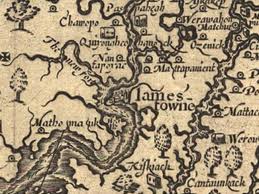
Example One (a map of the first permanent English settlement in Jamestown, Virginia.) This detail of Captain John Smith’s map of Virginia, published in 1624, shows that Jamestown is an admirably defensible site. (Note that north is to the right on this map.)
Example Two: ” The narrow isthmus connecting Jamestown with the mainland was under water during high tide; the peninsula itself jutted into the James, affording the settlers a view several miles up and down the river from where they built their fort. Two and a half centuries later, Confederate earthworks would be constructed on the 1607 fort site.”
Obtained from the National Park Service site, September 29, 2013 http://www.nps.gov/jame/a-defensible-site.htm
What two events are related here and what does this tell you about the location of Jamestown? Write your own short response, noting the relations.
A. Below are tips and answers.
The two related events are that the English used this location for their first permanent settlement, and the Confederates used this same site over two hundred years later. These two events are related because Jamestown was a highly defensible site given its access to waterways and the ability to see up and down the river for several miles.
Read the following passage from Martin Luther’s “I Have a Dream” speech:
“…Five score years ago, a great American, in whose symbolic shadow we stand today, signed the Emancipation Proclamation. This momentous decree came as a great beacon light of hope to millions of Negro slaves who had been seared in the flames of withering injustice. It came as a joyous daybreak to end the long night of their captivity….But one hundred years later, the Negro still is not free….
In a sense we’ve come to our nation’s capital to cash a check. When the architects of our republic wrote the magnificent words of the Constitution and the Declaration of Independence, they were signing a promissory note to which every American was to fall heir. This note was a promise that all men, yes, black men as well as white men, would be guaranteed the “unalienable Rights” of “Life, Liberty and the pursuit of Happiness.” It is obvious today that America has defaulted on this promissory note, insofar as her citizens of color are concerned. Instead of honoring this sacred obligation, America has given the Negro people a bad check, a check which has come back marked “insufficient funds.”
What does Martin Luther’s mean when he says the check has come back with “insufficient funds”?
A. All people are guaranteed rights by the constitution B. The slaves were freed a hundred years ago, but still are not free C. Citizens of color were not given the same “unalienable Rights” of “Life, Liberty, and the pursuit of Happiness” that the Constitution and Declaration of Independence declare for all Americans D. They were given a bad check.
C. Citizens of color were not given the same “unalienable Rights” of “Life, Liberty, and the pursuit of Happiness” that the Constitution and Declaration of Independence declare for all Americans
Put the following events in order: Sinking of the Lusitania, D-Day, Columbus sails, Declaration of Independence, Korean War, Assassination of Abraham Lincoln
A. D-Day, Columbus, Korean War, Assassination, Declaration of Independence, Lusitania B. Columbus, Korean War, Assassination, Declaration of Independence, Lusitania, D-Day C. Korean War, Assassination, Columbus, Lusitania, Declaration of Independence, D-Day D. Columbus, Declaration of Independence, Assassination, Lusitania, D-Day, Korean War
D. Columbus, Declaration of Independence, Assassination, Lusitania, D-Day, Korean War
Please read the article below and then take time to respond to the question.
Both Greece and Rome are Mediterranean countries, but the terrain of the two is very different. The ancient Greek city-states were separated from each other by hilly countryside and all were near the water. Rome was inland, on one side of the Tiber River, but the Italic tribes (in the boot-shaped peninsula that is now Italy) did not have the natural hilly borders to keep them out of Rome. In Italy, around Naples, Mt. Vesuvius produced fertile land by blanketing the soil with tephra which aged into rich soil. There were also two nearby mountain ranges to the north (Alps) and east (Apennine).
By N.S. Gill. Obtained from http://ancienthistory.about.com/od/greecevsrome/ss/GreecevsRome.htm
How were the ancient Greek and Roman countries similar and different? And further, how might natural geography affect, for example, a city on the water versus a city inland?
A. Tips and answers below.
Sample answer: They are similar in that they are both Mediterranean countries. They differ in their terrain. The ancient Greek city-states were separated from each other by hilly countryside and all were near the water. Rome was inland, on one side of the Tiber River, but the Italic tribes were not separated like the Greek city-states by hilly borders. A city inland might be harder to access. It might not be as economically prosperous as a city close to the water where ships can easily import and export goods.
In Abraham Lincoln’s Emancipation Proclamation, he declared:
“..And by virtue of the power, and for the purpose aforesaid, I do order and declare that all persons held as slaves within said designated States, and parts of States, are, and henceforward shall be free; and that the Executive government of the United States, including the military and naval authorities thereof, will recognize and maintain the freedom of said persons.
And I hereby enjoin upon the people so declared to be free to abstain from all violence, unless in necessary self-defense; and I recommend to them that, in all cases when allowed, they labor faithfully for reasonable wages.
And I further declare and make known, that such persons of suitable condition, will be received into the armed service of the United States to garrison forts, positions, stations, and other places, and to man vessels of all sorts in said service.
And upon this act, sincerely believed to be an act of justice, warranted by the Constitution, upon military necessity, I invoke the considerate judgment of mankind, and the gracious favor of Almighty God….” (January 1, 1863)
What was the purpose of the Emancipation Proclamation, and how was this supported by the American democratic ideals?
A. The purpose was to go to war with against the Confederacy. It was supported by American democratic ideals because it worked to preserve the Union. B. The purpose was to free the slaves. It was supported by American democratic ideals because it worked towards “life, liberty, and the pursuit of happiness” of all men. C. The purpose was to go to war against the Confederacy. It was supported by American democratic ideals because it freed the slaves. D. The purpose was to free the slaves. It supported American democratic ideals because it gave the slaves the right to vote.
B. The purpose was to free the slaves. It was supported by American democratic ideals because it worked towards “life, liberty, and the pursuit of happiness” of all men.
As part of the war effort, the government rationed foods like sugar, butter, milk, cheese, eggs, coffee, meat and canned goods. Labor and transportation shortages made it hard to harvest and move fruits and vegetables to market. So, the government turned to its citizens and encouraged them to plant “Victory Gardens.” They wanted individuals to provide their own fruits and vegetables.
Nearly 20 million Americans answered the call. They planted gardens in backyards, empty lots and even city rooftops. Neighbors pooled their resources, planted different kinds of foods and formed cooperatives, all in the name of patriotism.
(Obtained October 2, 2013 from Wessel’s Living History Farm York, Nebraska http://www.livinghistoryfarm.org/farminginthe40s/crops_02.html)
21. What are some of the economic impacts of war stated above?
A. There are no economic impacts. B. Labor and transportation shortages. C. Rationed foods. D. B. and C.
Read the following passage concerning the new Health Care law, referred to as “Obamacare”:
GOP United against Obamacare
By Ron Johnson
What can be done about Obamacare? For the majority of Americans opposed to Obamacare, it is a sad fact that as long as President Barack Obama is in the White House and Majority Leader Harry Reid’s Democrats control the Senate, repealing or defunding this monstrosity is next to impossible.
Elections have consequences. The 2008 election gave ideologically extreme Democrats the White House, a House majority and a filibuster-proof Senate, which allowed Reid to jam through Obamacare the morning of Christmas Eve 2009.
In 2012, Obama won another term and Reid maintained an iron grip on the Senate. That is a reality that cannot be ignored as strategies are developed to prevent Obamacare from taking firm or permanent root. Even so, opportunities abound to focus attention on the true harm this law is unleashing on the average American’s health care, on our struggling economy, on the federal budget and on our personal freedoms.
Reid and Sen. Max Baucus were correct in calling the implementation of Obamacare a “train wreck.” Numerous unions, strong supporters of the president and his party, are calling for relief. Even Obama acknowledged his administration’s inability to implement Obamacare ”” 31/2 years after its passage ”” by unilaterally delaying the employer mandate and income verification provisions of the law, an act the law doesn’t permit him to do.
Now is not the time for conservatives to turn a squabble over tactics into a circular firing squad. Now is the time to unite and fight to inform, persuade and win the argument, convincing the American people that Obamacare must be stopped….
We have Free GED Social Studies Practice Test HERE
Ron Johnson (2013, August 23). GOP United Against Obamacare. Retreived October 1, 2013 from http://www.jsonline.com/news/opinion/gop-unite-against-obamacare-b9981475z1-220849581.html
Would the above article be a good source for credible, factual information on Obamacare? Why or why not?
A. Find hints and answers below.
No. The writer has a clear bias against Obamacare. Consider the words “monstrosity,” “sad fact,” “train wreck.” The article is written to persuade readers against Obamacare, not provide clear, unbiased facts. This would be considered an opinion piece, not a factual piece.
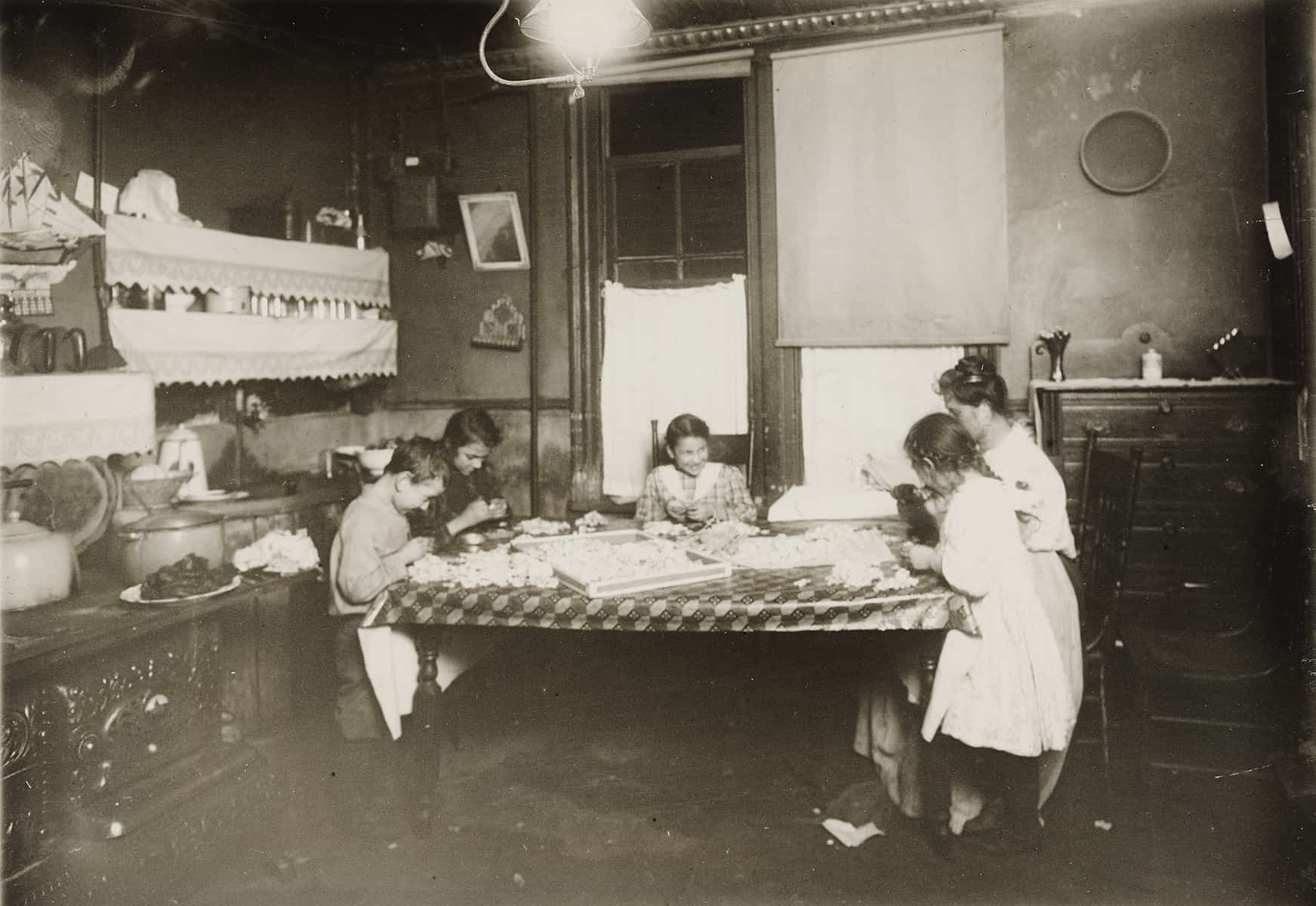
Consider the following picture taken in the early 1900s in the United States and the picture following.
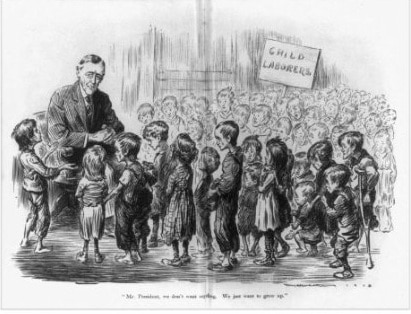
And this one of President Wilson surrounded by child laborers:
What event are these pictures most closely related to and why?
A. Civil War. Children were used in the North when the army was fighting in the South. B. Industrial Revolution. The rise of technological advances moved people from farms to factories. Companies, wanting to make money, profited in an unregulated work environment that exploited the use of children as laborers. C. Industrial Revolution. Children liked to play in the factories while their parent worked. D. None of the above
B. Industrial Revolution. The rise of technological advances moved people from farms to factories. Companies, wanting to make money, profited in an unregulated work environment that exploited the use of children as laborers.
16) How many branches of government are there in the United States government, and what system do they operate on?
A. Three: Executive, Judicial, Legislative. They operate on a system of checks and balances. B. Four: Executive, Judicial, Legislative, Presidential. They operate on a system of checks and balances. C. Three: Executive, Judicial, Legislative. They operate on a system of first among equals. D. Four: Executive, Judicial, Legislative, Presidential. They operate on a system of first among equals.
A. Three: Executive, Judicial, Legislative. They operate on a system of checks and balances.
25) What paved the way for the Industrial Revolution?
A. WWI””the clash of cultures brought together all kinds of ideas that paved the way for technological advances and, therefore, the Industrial Revolution. B. Scientific Revolution””people began to question the long standing teaching of the Catholic Church. Reason and knowledge triumphed. This paved the way for technological advances that would make it possible for the Industrial Revolution. C. Revolutionary War””the United States needed to make guns and this gave way to the rise of technology D. All of the above
B. Scientific Revolution””people began to question the long standing teaching of the Catholic Church. Reason and knowledge triumphed. This paved the way for technological advances that would make it possible for the Industrial Revolution.
22) What were the economic reasons that drove early exploration and colonization?
A. Profit (gold, land, use of natural resources) B. Fame (the need to be well-known throughout the globe) C. Power (explorers and countries wanted to have the largest kingdoms) D. None of the above
In John F. Kennedy’s Inaugural Address on January 20, 1961 he said:
“…And so, my fellow Americans: ask not what your country can do for you ”” ask what you can do for your country….My fellow citizens of the world: ask not what America will do for you, but what together we can do for the freedom of man….Finally, whether you are citizens of America or citizens of the world, ask of us the same high standards of strength and sacrifice which we ask of you. With a good conscience our only sure reward, with history the final judge of our deeds, let us go forth to lead the land we love, asking His blessing and His help, but knowing that here on earth God’s work must truly be our own.”
In President Kennedy’s address, he is appealing to what?
A. Individual rights B. Contain Communism C. Civic responsibilities D. Life, liberty, and the pursuit of happiness
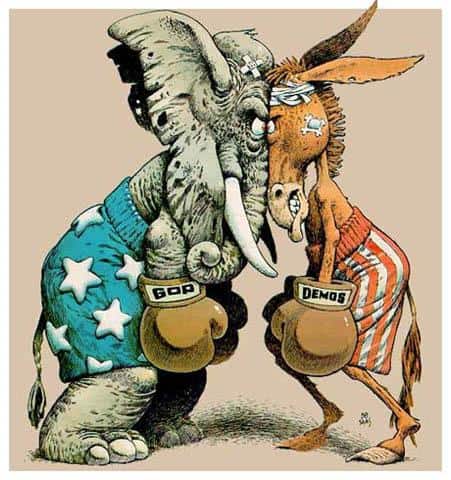
Write a short response to the political cartoon below.
Find hints and answers below
The elephant represents the Republican Party. The donkey represents the Democratic Party. They are fighting, so this represents the two sides not getting along””arguing. There is no compromise in the picture. They are angry””facing off, staring in each other’s eyes. They have boxing gloves on and are hurting each other. This could be a good example of the present time where the political parties are feuding and finding it difficult to compromise.
23) Clinton just opened his own cupcake business. He is trying to decide what the cost of each cupcake should be. This example falls best under which category:
A. Did not affect the economy B. Had a great affect on the economy C. Had a great affect on the economy and was the catalyst to put in place social programs that would forever change the United States economy. D. Had a great affect on the economy and was the catalyst to get us into WWII.
C. Had a great affect on the economy and was the catalyst to put in place social programs that would forever change the United States economy.