ACT Reading Practice Test
ACT Reading practice tests will introduce you to the actual test format. This will help ease your anxiety about the test and reduce the time you need to understand the test instructions.
Start Test
- ACT English Practice Test 1
- ACT English Practice Test 2
Learn The Tricks Of The Test To Get A High Score In ACT Reading
You can get a perfect score on the ACT Reading test!
Sounds like a far off idea? Not really! Even if you’re not a genius, it’s possible to score 36 on the ACT Reading test. You just have to study smart, learn the right tricks and tips and be sensibly intelligent to do so.
See our post here for some helpful ACT reading tips.
Two of the skills that you need on the ACT Reading test are pacing and strategy. Every answer is based on the passages in front of you, so learn efficient methods for reading each one. Time is of the essence in this test (as with all sections in the ACT test), that’s why you have to be as quick as you can in comprehending and looking for the best answers.
Our free ACT Reading practice tests help you get used to the structure of the test, so nothing on test day surprises you.
We have ACT English Practice Tests 2
Pick An ACT Reading Practice Test Here (link to TPT ACT Reading Practice Tests)
What’s In The ACT Reading Test? Here’s a brief description:
There are 36 questions in the ACT Reading test, and the time limit is 40 minutes. This test aims to measure your skills in reading comprehension. In the test questions, you’ll be required to draw meaning from various passages by referring to the ideas that are explicitly presented and apply reasoning to ascertain implied meanings. For the most part, the test will entail you to utilize your skills in reasoning and referring for determining main ideas, locating and interpreting important details and understanding the order of events, along with making comparisons, understanding cause-effect interrelatedness, ascertaining the meaning of words, phrases and statements that are dependent on context, deriving generalizations and analyzing the voice and method used by the narrator or author.
Learn more about ACT Reading Test Basics & Practices to Improve Scores
The test has several parts. Some have one long prose passage and others have two shorter passages, and one passage may include a graph, figure or table. The passages reflect the texts you would read in first-year college courses.
A heading before each passage identifies the author and source and may give background information. Each part is followed by a group of multiple-choice questions.
You will not be asked for the rote recall of details that are not found in the passage or of isolated vocabulary. Knowledge of the rules of formal logic is not required. In parts with two short passages, some questions ask about both.
Four scores are reported: an overall reading score and three category scores based on specific knowledge and skills.
We have a Practice Test that you can use: ACT English Practice Tests
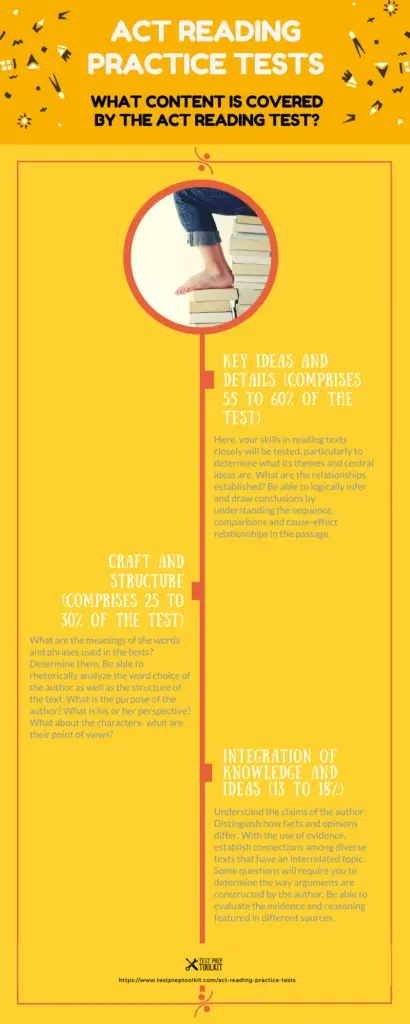
What Content Is Covered By The ACT Reading Test?

Key Ideas and Details (comprises 44 to 52% of the test)
Here, your skills in reading texts closely will be tested, particularly to determine what its themes and central ideas are. What are the relationships established? Be able to logically infer and draw conclusions by understanding the sequence, comparisons and cause-effect relationships in the passage.
More review materials: ACT English Practice Tests 3
Craft and Structure (comprises 26 to 33% of the test)
What are the meanings of the words and phrases used in the texts? Determine them. Be able to rhetorically analyze the word choice of the author as well as the structure of the text. What is the purpose of the author? What is his or her perspective? What about the characters- what are their point of views? You have to be able to rhetorically interpret the decisions of the author and differentiate various perspectives and information sources.
Integration of Knowledge and Ideas (19 to 26%)
Understand the claims of the author. Distinguish how facts and opinions differ. With the use of evidence, establish connections among diverse texts that have an interrelated topic. Some questions will require you to determine the way arguments are constructed by the author. Be able to evaluate the evidence and reasoning featured in different sources.
Pick An ACT Reading Practice Test Here (link to TPT ACT Reading Practice Tests)
Related Topics:
- How To Improve ACT Reading Score
- ACT Test Dates for 2021-2022
- ACT Reading Test
- ACT Scores
- ACT Registration And Requirements
- How To Get Good ACT Scores?
- 5 Reasons Why You’re Getting A Low ACT Score And What To Do About It
- Why You Need Help In Preparing For Your ACT Test